
Lamar County Criminal Docket Searches
Every Lamar criminal docket search starts with one question: which court got the case? The Lamar County Circuit Clerk is the named starting point. The office covers Circuit and County Court records. Is a file eligible and unrestricted? Then you can reach it electronically through Mississippi Electronic Courts, or MEC, via PAMEC. Justice Court and city matters go to their own clerks instead. There is no free, anonymous county-wide docket form for all Lamar cases.
Bring the exact case number when you contact a clerk. Check any notice, order, receipt, or old docket sheet for one. The full Lamar case-number format is not public. Never build a number from a code. Without it, give the court, the party name, an approximate filing year, and the case type. That is usually enough for the clerk to locate the court record.
- Identify whether the Lamar matter belongs in Circuit, County, Justice, Youth, or municipal court.
- For eligible Circuit or County cases, review the PAMEC non-attorney terms and register before using the electronic docket layer.
- Use the exact case number or the search fields available after sign-in, then confirm the court and case type before opening a result.
- For a Justice Court or municipal matter, contact that Lamar court directly and ask whether it has a public docket, paper index, or clerk-assisted search.
- Request a plain docket sheet, filed order, judgment, or certified copy by name when a particular record is needed.
Note: A missing online result has several innocent explanations. The file may be old, sit in a different court, carry a restriction, or be available only through the clerk.
Lamar Criminal Docket Codes
The Circuit Clerk publishes code families. They describe what kind of Lamar criminal record you are after. Treat them as routing clues. They are not a public case-number formula. A code never says anything about the outcome of a case. Read each one alongside the court name, the docket entries in order, and any controlling order. Some categories on the clerk's list carry special access limits too. So a label alone never proves a file is open for inspection.
- CF
- Criminal Felony on the Circuit Clerk's published list.
- CM
- Criminal Misdemeanor on the published list.
- DT
- DUI on the published list.
- TR
- Traffic on the published list.
- CC
- Criminal Contempt on the published list.
The Circuit Clerk code list also shows JA, JD, and J for juvenile-related categories. Those labels are part of the Lamar record map. They are not an invitation to hunt for confidential Youth Court material. Ask the lawful custodian about access rather than assuming a code makes a record public.
Criminal Dockets: What They Show
A Lamar criminal docket is a chronological court record. It is not one tidy statement of what happened. Expect to see the court, the exact case number, a local code, the filing date, future settings, entry titles, bond or financial notations, and access flags. When you need the result of a motion, plea, or sentence, the actual order or judgment controls. A scheduled setting can change later. A financial entry is not a finding of guilt.
This record is not an arrest log, jail roster, warrant checker, or full criminal-history report. It logs court activity for one case, within whatever access limits attach to that file.
| Court | Distinguishes Lamar Circuit, County, Justice, or a municipal court and its separate custodian. |
|---|---|
| Case number | Use the exact number shown. Lamar's public format was not located without a PAMEC account. |
| Code and filing date | Places a CF, CM, DT, TR, CC, or other listed category in time without equating it to an outcome. |
| Setting and entry | Shows a date, time, location or label, plus chronological filings, notices, or order titles. |
| Disposition and access | Read the judgment or controlling order; note any bond, restriction, expungement, or appeal entry. |
For Lamar Circuit and County Court, the public Fifteenth Circuit MEC court-information page names the court system and its status vocabulary. It offers system information, not a results table. The docket itself, plus confirmation from the clerk, is still the safer route for tying a label to a particular court file.
Lamar Justice Court Bond Route
Lamar County Justice Court plays its own criminal role. Per the county, it handles misdemeanors, traffic, DUI, game and fish matters, MDOT tickets, felony bonds and preliminary hearings, search warrants, initial appearances, and bond hearings. For some early criminal proceedings, that makes Justice Court the first stop, even if a felony later shifts to a different court. Any clerk-assisted search has to begin with that distinction.
The official Justice Court page sets misdemeanor pleas at 10:00 a.m. Tuesday and misdemeanor trials at 1:30 p.m. Tuesday. Those are recurring court times. They do not promise that your Lamar case is set on any particular Tuesday. Confirm the current setting, location, and reset status at 205 Main Street, Suite A, Purvis, or call (601) 794-2950.
The county page gives no date for that figure. It does not break out charges, results, or court levels. Treat it as a workload indicator, not a current total for every Lamar criminal docket.
Criminal Case Stages on the Docket
A Lamar criminal docket often opens with a filing or charging entry. An initial appearance or arraignment may follow. Where it applies, the record can show probable-cause, bond, or preliminary work. That comes before pretrial motions or an intervention stage. Later entries might cover a plea or trial setting, a verdict, and then a sentence. Costs, probation, or another order may follow. Closure, appeal, or expungement can round out the final status.
Docket flow: Filing or charging → initial appearance or arraignment → probable cause, bond, or preliminary stage → pretrial motions or intervention → plea or trial → verdict or disposition → sentence, costs, probation, or order → closed, appeal, or expunged status.
Not every Lamar criminal case hits each step, and a docket's sequence should never tempt you to fill gaps with assumptions. A case can, for instance, move from Justice Court preliminary or bond activity into a later Circuit Court stage. The entry and the order identify what actually happened in the court that made them.
Lamar Criminal Pending Flags
MEC case headings in the Fifteenth Circuit carry a vocabulary of stage labels. Some mark early steps: Arraignment Pending, Trial Pending, and Plea Pending. Others read For Sentence, Probable Cause, BOUND OVER, Final Judgment Issued, and Probation. Each label points to a stage in the case. None is a result. A pending flag shows the stage the system recorded, not a disposition. The same caution applies to Probable Cause and BOUND OVER. Neither label alone proves a final outcome.
Check the newest dated entry before trusting any flag as current. Then read the matching order. A Final Judgment Issued label should end at the judgment document itself. A probation label should end at the operative order. CourtInfo also lists sealed and restricted labels. So a case heading that appears may still carry little material. Read the whole Lamar court record, not one status word on a docket.
Lamar County Criminal Docket Courts
Which court holds the file depends on the charge. Circuit Court of Mississippi, Fifteenth Circuit District, handles felony criminal work. It is the general-jurisdiction trial court. The Circuit Clerk keeps those Lamar Circuit and County Court records. Justice Court handles the lower-court matters described above. Purvis, Sumrall, and Lumberton municipal courts each keep their own files. City ordinance and limited criminal cases live at the city court that heard them, and so does that docket.
Lamar County Circuit Clerk
203 Main Street
Purvis, MS 39475
P.O. Box 369
Purvis, MS 39475
(601) 794-8504
The Circuit Clerk's office page names Martin Hankins and describes the office's recordkeeping role. Request a Lamar Circuit or County Court docket there. Name the document you need. That could be a docket sheet, filed order, judgment, or certified copy. A municipal case belongs to the city court that holds it.
Lamar Criminal MEC Access Boundary
Lamar Circuit Court and Lamar County Court joined Mississippi Electronic Courts. The go-live date was November 4, 2019, per the Fifteenth Circuit MEC page. That go-live date explains a split. Electronic access covers records from one era, and paper or legacy files from another. It does not promise that every later Lamar criminal record is public online. Nor does it mean earlier records are unavailable.
PAMEC is the public account layer for participating, non-restricted electronic courts. Non-attorney accounts cost $10 per year. Each page a search returns costs $0.20. That applies even when the only page returned shows no match. Those are online search charges, not a clerk-copy or certification fee. If a Lamar search fails, ask the custodian what happened. The matter may predate MEC, sit in another court, or be restricted. A courthouse terminal may also offer a check.
The Mississippi Electronic Courts system is separate from attorney filing access. It is also separate from any municipal-court request. No account result is a complete county-wide criminal index.
Access Rules for Criminal Dockets
Mississippi's Public Records Act of 1983 opens the door to public records in Lamar County. But it has limits. It cannot override a judge's sealed-case order, juvenile confidentiality, or protections for personal information. PAMEC's electronic-access terms also stand apart. So before you file anything, ask the clerk first. Tell the clerk with custody of the record exactly what you want. Say whether it's the public docket, a filed order, a judgment, a plain copy, or a certified copy.
Public-access boundary: The Mississippi Public Records Act information page identifies Miss. Code §§ 25-61-1 et seq. and explains access, exemptions, fees, procedures, and complaint information. It is not a guarantee that a judicial, sealed, juvenile, or restricted Lamar file can be released.
If the clerk denies or limits your request, push back with questions. Ask what legal basis applies. Ask whether a redacted copy exists. Also ask whether narrowing the request would help. Keep copies of everything: the request, the reply, the fee quote, and the date you sent it. A docket entry or written court order beats any guess drawn from a missing search result.
Lamar County posts a general contact route. But a criminal case-record request belongs with the clerk who keeps the file. A general form is not the place for sensitive details unless that office asks for them through a proper channel.
One last distinction matters. A plain docket sheet and a certified judgment are separate requests, so pin down the exact Lamar record before discussing payment or delivery.
Lamar Juvenile Docket Boundary
In Lamar's published code list, the Circuit Clerk uses JA, JD, and J labels. They mark juvenile abuse, juvenile delinquency, and juvenile categories. Those labels do not turn the files into ordinary public docket material. Youth Court records demand special handling. The right route runs through the public office and its lawful access process. It is not a broad online search. It is also not a request for private case details.
For an administrative question, the county's Youth Court department route is the right Lamar starting point. When you want a record, name the court and the specific public item first. Then ask whether access is permitted. A sealed, expunged, or restricted file is not missing, erased, or proof of any outcome unless the controlling order or clerk says so.
That access route marks a real boundary. A published criminal code sits on one side, and a record with separate confidentiality protections sits on the other. The official Youth Court page reflects that split.
Honor that line when you work a Lamar County criminal docket. It keeps your court routing accurate and stops confidential juvenile material from being treated like a routine public criminal case.
Lamar Circuit Criminal Record Route
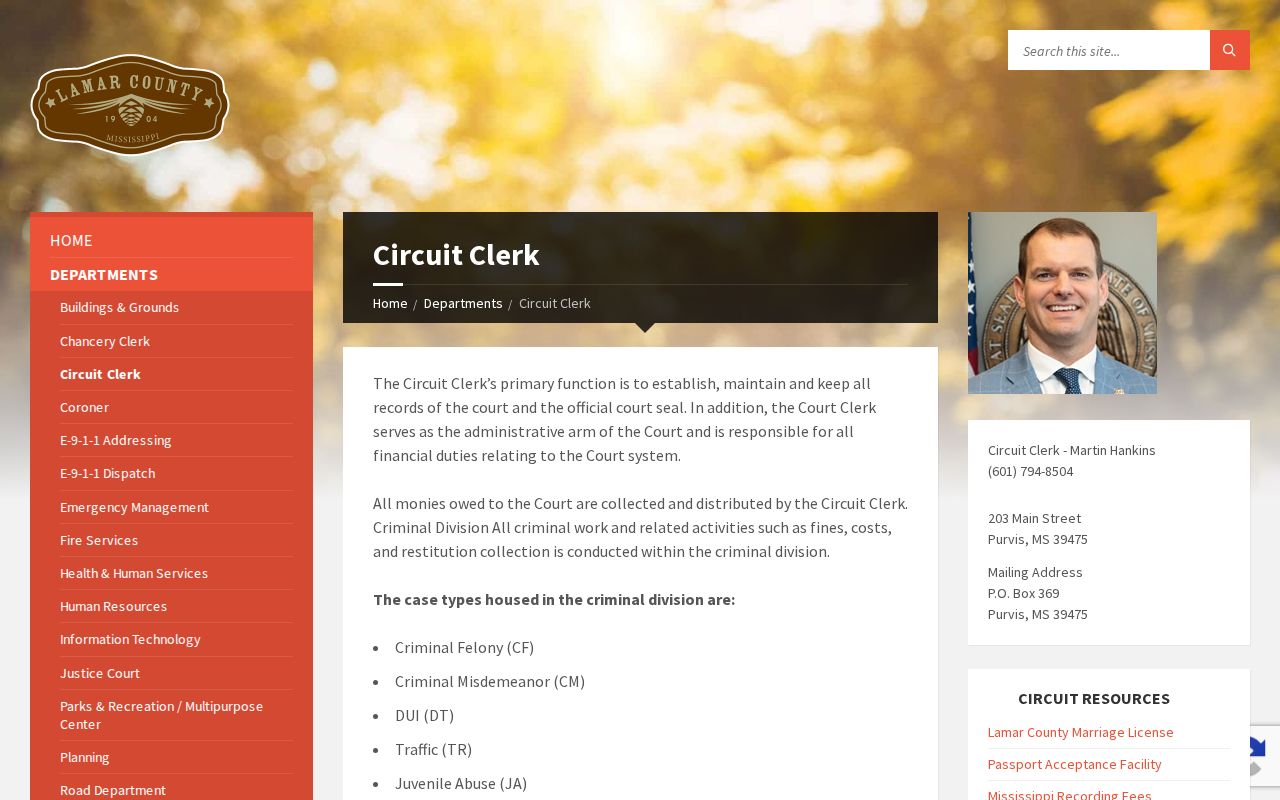
Start with the codes. The Lamar County Circuit Clerk keeps a criminal-code list that sorts offenses by division, so a requester can tell whether a case sits in Circuit Court or County Court. That step matters. Naming the court and the charge category up front saves time at the counter and money on electronic copies. For status flags and the electronic filing environment, the Fifteenth Circuit's MEC material picks up where the code list ends, showing how a Lamar County criminal docket entry is flagged once it is in the system.
The clerk's official Circuit Clerk page lays out that local code structure for anyone tracing Lamar County criminal docket records.
Codes describe a record. They do not summarize it. Once you have pinned the right code, go to the docket sheet, the filed order, or the judgment for the case-specific facts that no code can supply.